HealthIMPACT Brief: The Best Rooms Run on Shared Ownership
Fall Forum speaker preview, built from six Digital Health Talks episodes. Draft as of September 30, 2026.
The HealthIMPACT Brief, tenth edition. Six Digital Health Talks conversations, and a preview of the room we're all walking into next week at the HealthIMPACT Fall Forum.
The best rooms my guests described this season all had the same thing going for them: everyone in the room owned a piece of the work, and everyone could see the whole of it. That turns out to be exactly what health system AI is short on right now, which is why I wanted to put these six conversations side by side a week before all of us end up in the same room.
Some context on how I got here. This season on Digital Health Talks I stopped asking guests to walk me through their résumés and started asking something I actually wanted to know: what's the best room you've ever been in? I'd toss out a few examples to get them going, a boardroom, a green room, a wine cellar in Tuscany, and I'll admit the Tuscany option was mostly for my own benefit. Christine Williams of Foxtrot Services was tempted. Nobody actually took it.
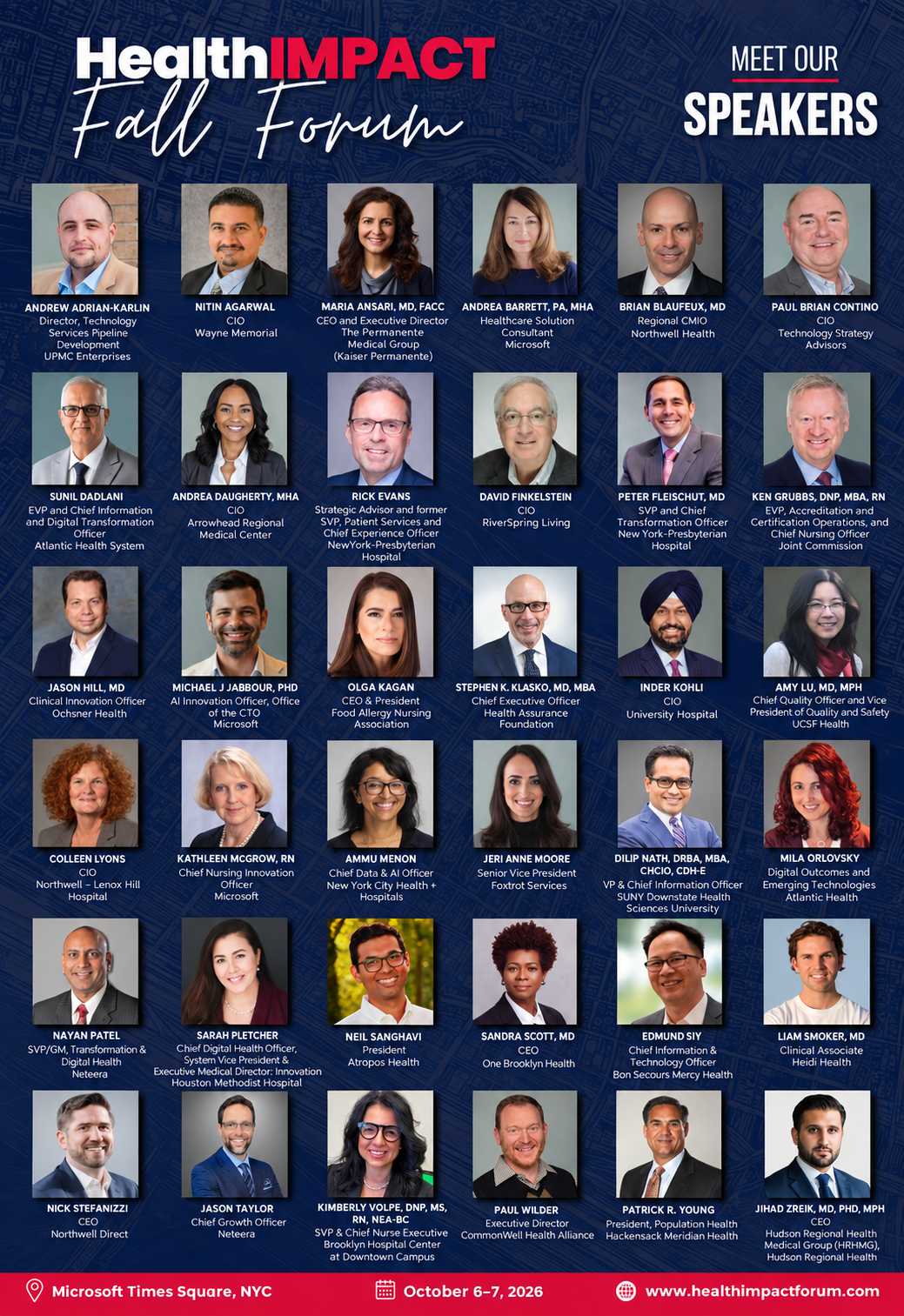
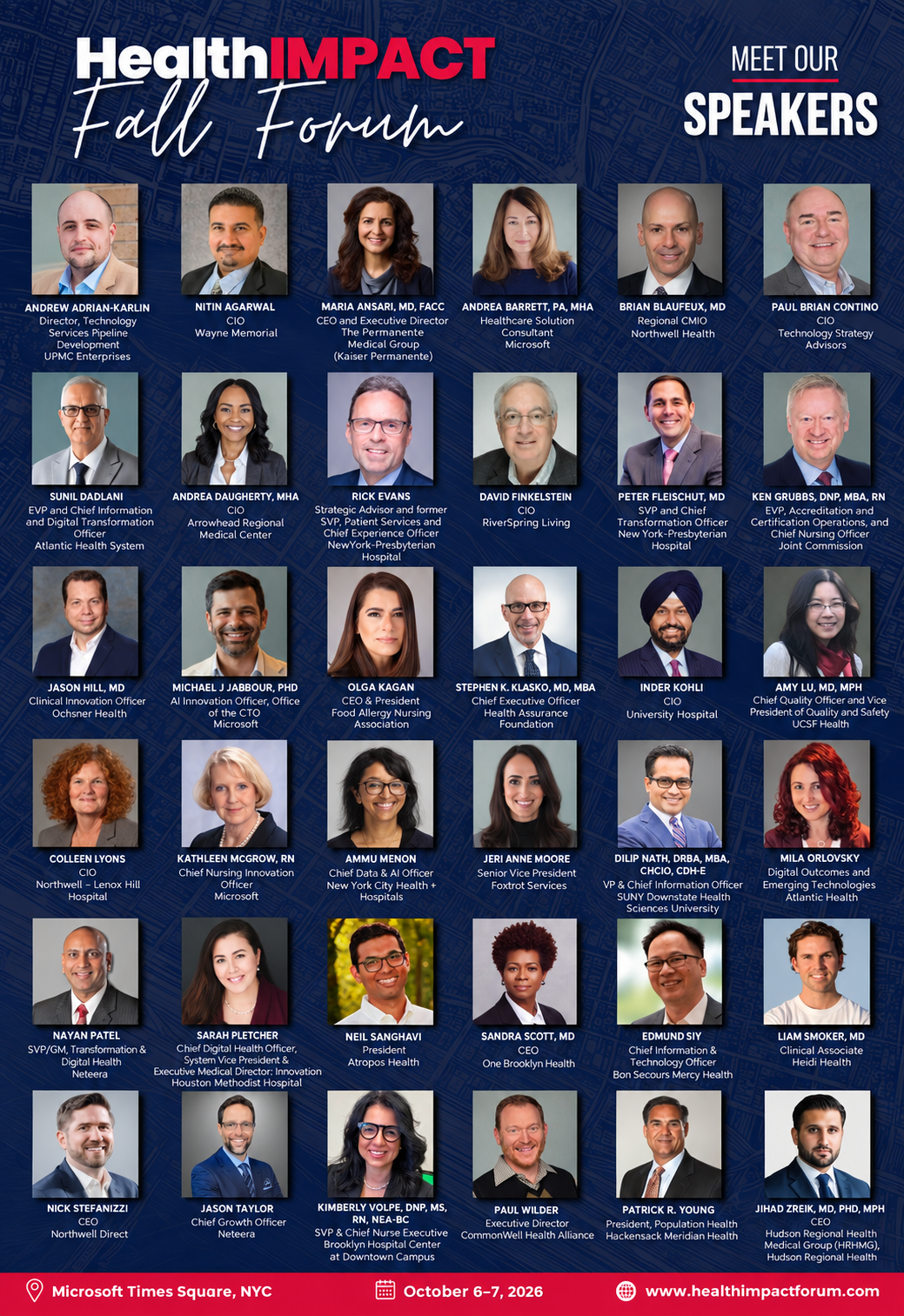
The Forum is October 6 and 7 at Microsoft Times Square in New York, and in the interest of full disclosure, it's ours. HealthIMPACT Live produces it, so I'm not a neutral observer here, and you should read the rest knowing I've spent the better part of a year building the agenda this piece points to. The episodes were recorded [dates to confirm], and all six are on Digital Health Talks.
Six rooms, one pattern
Brigham Hyde [LINKEDIN], CEO and co-founder of Atropos Health, picked a dinner. Every year he hosts one at Carbone in Las Vegas the Sunday before HLTH, with people from health systems, pharma, venture and policy around the table. Last year the conversation turned to why everyone had gotten into this work, and he said every single person had a story about a patient. I loved that answer, partly because convening rooms like that is literally my job, but mostly because of what it says about what happens next. Once everyone at the table admits why they're there, the conversation gets honest quickly.
Edmund Siy [LINKEDIN], chief information and technology officer at Bon Secours Mercy Health, spent years running technology at Warner Music and Warner Bros. before healthcare, and he picked the Eastwood Scoring Stage on the Warner Bros. lot, where an orchestra records music against the picture on screen. What he loved was the synchronization, a room where, as he put it, "everyone has a part to play."
Ben Smith [LINKEDIN] of SailPoint, which is a Digital Health Talks program partner, went somewhere less glamorous and maybe more telling: a hospital incident command center during a downtime drill that ran from 10 p.m. to 2 a.m., when the EHR went to paper. The silos that normally keep clinical leadership, IT, biomed and nursing administration in their own lanes simply fell away, and he watched a chief medical officer and a security architect work the same whiteboard toward one goal, patient safety and keeping care going.
Sarah Schmidt [LINKEDIN], co-founder and CEO of Cambrian Health, picked the leadership team at Forward, where she worked before the company closed. She described it as a room full of the smartest people and also the lowest-ego people, who did their best work when things were hardest. Christine Williams [LINKEDIN] and Nicole Sanders [LINKEDIN], co-CEOs of Foxtrot Services, a Gold sponsor of the Forum, both reached for rooms built on respect, active listening, hard work and a shared mission. For Christine, that's the company the two of them built.
Nick Stefanizzi [LINKEDIN] of Northwell Direct is the one guest whose episode didn't include the question, though as you'll see, his whole business is a room of exactly this kind.
Put those answers next to each other and nobody described a room where the smartest person won the argument. They described rooms where ownership was clear and shared, and where people could see past their own piece. Then, when we got to AI, each of them described a place where that's exactly what is missing.
The agents have the keys, and nobody owns them
Ben's version is the one I keep repeating to CIOs. When a health system turns on an AI agent, he said, it hasn't added a piece of software. It has "actually hired a digital employee" that works around the clock at machine speed, with standing access to clinical and financial systems and, very often, no manager. His test for whether governance is working comes down to one question: can a person reach data or tools through an agent that they couldn't reach on their own?
He also made the point that agents need two kinds of review where most programs run one, a check on what the agent can touch and a check on who, and which other agents, can reach it, and that those reviews should happen whenever the agent is created, changed or retired rather than on a 30, 60 or 90 day calendar. The ownership question is very literal for him. Service accounts sometimes sit with the server team, agent builders sometimes create their own, and if identity and access management ends up inheriting all of it, he said, somebody needs to reopen that team's budget. That scope is only getting bigger, since Epic says Agent Factory, its tool for customers to build their own agents, will expand to external connectors and partner platforms. On Day One, that conversation happens in Securing the Machine Workforce at 1:45, with Dilip Nath of SUNY Downstate Health Sciences University and Shahid Shah moderating, and over lunch at the security and identity table SailPoint is hosting.
If you're a CISO or CIO, the useful thing to do before next week is decide which team owns non-human identity, and fund that team for what it's about to inherit.
"Wait for Epic" is usually a queue problem
Edmund's approach at Bon Secours, which he described as more than 1,000 points of care across seven states plus Ireland and an office in the Philippines, starts with three core partners: Epic, Microsoft and Workday. If that foundation covers 80 to 85 percent of what the organization needs, his team can put its energy into the rest, whether that means partnering, building, or taking a short-term option and coming back to Epic once Epic catches up. "We're not afraid to look at anything. It just has to make sense."
Sarah hears "what if Epic builds this?" from almost every buyer, and her view is that the question is really a symptom. She said every system Cambrian has worked with names the IT queue as its biggest threat. A decision maker says yes, and then, in her words, "They put it in a queue and it sort of goes there to die." She was careful to say IT isn't the villain, since that queue is full of things the system already approved, which is exactly why waiting six months for Epic starts to look like the easier path. Her summary: "These are operational problems, not technological problems." Nicole added the practical answer, which is that it doesn't have to be either/or. You keep modernizing the core and run newer data and AI tools alongside it so they're useful in the meantime.
Edmund takes this on Day One at 9:30 in The Architects' Scorecard, alongside Peter Fleischut, MD of NewYork-Presbyterian, Michael Jabbour of Microsoft and Ammu Menon of NYC Health + Hospitals, and it comes right back at 11:15 in Systems That Scale Without a Bigger Budget, moderated by Foxtrot's Jeri Anne Moore with Surgence. My suggestion for CIOs: find out how long approved projects actually sit in your intake queue. If it's longer than the roadmap you're waiting on, waiting isn't the cheap option.
Saved hours only count if someone decides what to do with them
Christine put this better than I could: "if somebody saves two hours and simply fills in those two hours with more administrative work, you've improved a task, but you haven't necessarily changed the outcome." Nicole followed with the part leaders like hearing less, which is that someone has to decide what to do with the capacity they've created. "There is no magic wand here."
Then there's the bill. Christine said Foxtrot regularly meets clients whose compute costs are high and tied to no particular outcome, and Nicole said some of their engagements have cut compute costs on the order of 90 percent in the first two weeks. That's Foxtrot's own account of its client work, with no published methodology, so treat it as something to test rather than a benchmark. The way she explained how it happens was more convincing than the number: twenty departments each building AI around the same thing, say a piece of medical equipment, can multiply compute twentyfold and leave behind tech debt that someone eventually has to untangle.
Edmund is watching the same line from the CIO's chair. Tokens are a big variable cost his team is still getting its hands around, hardware is up by double digits as data center buildouts pull on supply, and he expects the One Big Beautiful Bill Act to start landing on health system budgets next year. One of his answers was a hire: Dylan Clark joined Bon Secours Mercy Health on February 16 as chief analytics and AI officer, reporting to Edmund and overseeing an AI governance framework, and what Dylan brought, Edmund said, was discipline. Both Day One morning sessions get into this, and so does the supply chain and cost savings table Foxtrot is hosting at lunch. If you're a CFO or CIO, ask for the compute bill broken out by workload before you come, and see which lines you can tie to an outcome.
The evidence exists, and getting it into the visit is the hard part
Brigham starts from his company's figure that only 14 percent of daily clinical decisions are backed by high-quality evidence. I couldn't find the study behind that number, so I'd cite it as theirs, but the gap he describes is real to anyone who has read a trial's exclusion criteria: patients with several conditions, older adults, children, pregnant patients. As he put it, if no study matches the patient in front of you, "it doesn't matter how good your LLM is." Atropos's answer is to produce the studies. Its Alexandria library now holds more than 500 million precision findings, with a stated goal of 2 billion by the end of 2026, and its evidence agent runs inside Microsoft Dragon Copilot at Stanford Medicine, so the evidence shows up during the visit without anyone having to ask. He was also direct that none of it matters without trust, which is why Atropos publishes its methods, puts an evidence-quality badge on every answer, and paid an outside publisher to peer-review a 1 percent slice of the library.
Sarah is working the other end of the same problem. The 2026 AHA/ACC/ADA/ASN cardiovascular-kidney-metabolic guideline recommends checking urine albumin-to-creatinine ratio alongside eGFR, so Cambrian built that test into its protocol, and its early clinicians quickly found that most patients had never had it done. Rather than refuse to give an answer, the team turned the missing test into a recommendation and worked from the data clinicians did have. Her line on all of it: "knowing what to do hasn't been the problem within healthcare for a really long time."
The way I'd put the two together is that Brigham is short on studies for the patient in the chair, and Sarah has the guideline but can't get it into the visit, and a health system needs both. Atropos's president Neil Sanghavi joins Andrea Barrett of Microsoft for Evidence at the Point of Care on Day One at 2:30, and Sarah is on It's the Change, Not the Tech on Day Two at 3:00 with Brian Blaufeux, MD of Northwell Health, Jason Hill, MD of Ochsner Health and Kimberly Volpe, DNP of The Brooklyn Hospital Center. For CMIOs and CNIOs, pick one guideline and look at how often the test it requires actually gets ordered. That number tells you more than any demo will.
Nick built the room the rest of us keep describing
Nick didn't get the best-room question, but listen to how he describes his business. Northwell Direct contracts directly with self-funded employers and unions, and since its first customer in 2022 it has grown to more than 300,000 members from more than 75 employers and unions, with 97 percent retention and average savings of about 20 percent. Its contract with the 32BJ Health Fund covers 170,000 participants and cut inpatient copays from $1,000 to $100. When I asked what actually drives the results, his first answer was about the room: "We're sitting at the table with the employers and the unions that we serve. We're looking at the data together."
He was just as clear about ownership. Northwell decided to "deconstruct the health plan," owning the network and the care management and partnering for claims, utilization management, stop-loss and pharmacy benefits, partly so the people approving care aren't the people delivering it. And when it comes to carriers that won't give employers their own claims data, he was nicely dry about it: "I don't really believe in coincidences." For the CFO wondering whether this just discounts care for patients you already had, HFMA reported that Northwell Direct tracks exactly that, with conservative definitions of existing members compared against what each new employer group brings in. Nick is on Where the Payment Is Moving on Day Two at 10:45 with Maria Ansari, MD of The Permanente Medical Group and Patrick R. Young of Hackensack Meridian Health, which is also where Sarah's CFO, the one asking where the return is when heart failure admissions drop, should probably be sitting.
The other room this week
On Tuesday, the heads of most of the major AI companies sat down together in the East Room of the White House and signed a voluntary accord on what the administration is now calling superintelligence. The reaction has split the way you'd expect, and critics in the Senate are already calling the pledge toothless. Whether it holds is an open question, and a voluntary pledge is only as good as the people who keep it.
But set the politics aside for a second and look at the room itself. Companies that compete for the same talent, chips and customers agreed that some principles have to sit above any one of them, which is how one attendee described it: shared standards rather than everyone for themselves. Even the people building the most powerful technology on the planet decided the next step required being in one room together.
Every section above is the health system version of that same moment. Who owns the agents. Who owns the queue. Who owns the compute bill. Who owns the evidence, and who owns the math when heart failure admissions fall. None of those questions belongs to one department, and none of them gets answered in a conference room in your own building.
Why the room matters
Lisa Stump, executive vice president and chief digital information officer at Mount Sinai Health System, said it on our stage in February: "Innovation moves at the speed of trust." I keep coming back to that line, because it explains what every one of my guests' rooms had in common.
Trust doesn't come from a contract, a webinar or a vendor deck. It comes from people making a commitment in front of each other, owning their piece of it, and then showing up again to prove they meant it. You can see it in every conversation above. Ben's CMO and security architect earned it at a whiteboard at 2 a.m. Nick's employers earned it by looking at their own claims data with the health system instead of guessing at it. Brigham is trying to earn it for evidence by publishing his methods and paying someone else to check his work. Shared ownership is what turns a commitment into trust, and you can't build that over email. You build it in a room.
That's also the honest test for the accord signed in the East Room this week. A signature is a start. The trust comes from what the people who signed it do next.
Why we're getting in the room
That's the reason the Fall Forum exists. Next week, health system CIOs, CMIOs, nurse executives, CFOs and the companies building alongside them will be in one room at Microsoft Times Square, and by the end of day two we'll leave with the HealthIMPACT 2027 Decision List, built from what that room commits to together. Then we'll come back and hold each other to it.
If you're coming, bring the person who owns the other half of your problem. The CFO to the compute conversation. The CISO to the agent conversation. The CNIO to the evidence conversation. My guests told me what a great room feels like. Now we get to build one.
Previously in The HealthIMPACT Brief: Longevity Just Quietly Exited the Wellness Aisle, the last piece in our series on the Digital Health Innovation Summit. Next: [confirm, likely the HealthIMPACT 2027 Decision List after the Forum].
Hear the full conversations on Digital Health Talks: Edmund Siy, Ben Smith, Christine Williams and Nicole Sanders, Sarah Schmidt, Brigham Hyde, and Nick Stefanizzi.
Health system registration is free and the room is capped at 300. If you run technology, clinical operations or finance at a health system and haven't registered, you can do so here.
HealthIMPACT Fall Forum Oct 6 & 7 NYC Register at www.healthimpactforum.com
You leave with the HealthIMPACT 2027 Decision List, built by the Champions of Care in the room, on what to scale, what to retire, and what to fund next. And the conversations, the calls, and the friendships keep going long after you leave Times Square.
You're going to make these calls either way. You can make them on your own, or you can make them after two days with people who've already made a few of them.
IMPACT happens October 6 and 7 at Microsoft Times Square. Health system passes are $399, and if budget is the barrier, send me a message and I'll get the car back on the road.
HealthIMPACT Briefs are insights from healthcare conferences, our own and others, written for the C-suite leaders who could not be in the room.
HealthIMPACT Live convenes the rooms where health system C-suite technology leaders solve this work together. The Operators Table dinner series, the HealthIMPACT Fall Forum, and the Digital Health Talks Podcast. Subscribe to the newsletter at healthimpactlive.com.