Epic Came Down-Market. Desperation Was Already There
The fifth edition of The HealthIMPACT Brief, an editorial series amplifying the conversations happening on the stages and in the hallways of healthcare’s best events.
What Epic's user meeting said about where care is going, for the leaders who could not be in the room.
“Clinicians adopt AI at the speed of trust. Patients adopt it at the speed of desperation.”
Sue Sheridan, president and CEO of Patients for Patient Safety US, said it. Carl Dvorak, Epic president, put it on screen during the international segment at Epic's Users Group Meeting last week, and John Lynn caught it.
Epic UGM ran August 17 to 20 in Verona, Wisconsin, themed Meet Me at the Midway. According to Beckers, more than 20,000 people on site, nearly 500 sessions, and another 60,000 watching Tuesday's General Session. Epic's own program copy promised a 4-H tent dinner and an expo better than prize pigs or pies, and then most spent the rest of the week litigating antitrust theory over a county fair.
I was not one of the twenty thousand. I have never been to UGM. Everything here comes from people who were in the room and from Epic's own materials. Almost everything written since has been an argument about Epic's market power, which is an argument about vendors. Sheridan's line is an argument about patients, and the most interesting thing Epic did last week was aimed squarely at the places where patients run out of options first.
The announcements matter. What matters more is what they require you to do differently before 2027. I came away with four decisions I would put on the agenda before budget season.
Epic spent the week absorbing your vendor list
Judy Faulkner opened with a scorecard. Of 167 major projects named at last year's UGM, 84 were completed on time and 76 are on track. Then came the list. Agent Factory. EpicOps moving into workforce, supply chain, and financials. Savvy, which collects payments without a payment gateway. Integrated eFax, which I assume ruined somebody's quarter. Real-time prior authorization wired straight to UnitedHealthcare and Aetna. Autonomous coding in radiology and emergency medicine. Ergo in November, packaging Art, Emmie, Penny and Cosmos into one interface.
Epic did not launch products last week. It absorbed categories. David Chou put it plainly at Forbes: features that used to be separate add-ons keep becoming core. Every item on that list was a line item in somebody's contract last year, and it is arriving faster than anyone can take it in. Epic's release cycle has gone from roughly 18 months to three, with more code in the three-month releases than the old 18-month ones carried.
If you run health IT: your next vendor evaluation is an Epic overlap evaluation, whether you scheduled one or not.

There is a big garden on the runway. AI generated image of Shetland pony in a garden on a runway.
Epic came down-market. Distance did not move.
Every major vendor is moving toward mid-size systems, small hospitals, and non-Epic shops right now. Epic went the furthest, and the trade press reported it accurately, then moved on to the AI slides. For most of its history, you had to be a large organization to buy Epic at all. Last week Judy walked through a product line built for everyone else. Orchard for small organizations. Garden Plot for specialty cooperatives. Flower Pot for the very small. Inpatient Garden Plot for small hospitals. Somebody in Verona committed very hard to the garden. Then, presumably to get out ahead of the walled garden jokes, they introduced Rangers. That one comes at it from the labor side, long-term embedded Epic staff placed onsite, which tells you something about how hard experienced analysts are to find outside a major metro.
Modern Healthcare framed the week as happening amid leadership change and reported antitrust scrutiny. A company under that kind of examination just announced a product line for every organization previously too small to be a customer. That is not a company pulling back. And market share is only half of it. John Lee argues in The Epic Edge that Cosmos, not Ergo, is the real moat, a 320-million-patient database no competitor can rebuild. Every small hospital that signs on also feeds the asset. Which is the whole question. Feeds the asset, or reaches the patient.
The record travels further than the care
Amy Oliver, who founded Azul Heart, wrote about her grandmother's last six weeks in a nursing home in rural Pennsylvania. The doctor came once a week. Roughly 144 hours between visits, as she puts it, with LPNs and aides carrying the decisions. Read her piece. Distance is not miles. Distance is the gap between a patient and the person who can decide, and it can be six days wide inside a building full of staff.
Lisa Stump, EVP and chief digital information officer at Mount Sinai, gave the corollary at HealthIMPACT in February. Innovation moves at the speed of trust. Put her line next to Sheridan's and you have the whole problem. Innovation waits for trust. Trust gets built locally and slowly, by people. Desperation waits for nobody.
Epic named Care Everywhere two decades ago, and it has earned the name. Records follow a patient between institutions at a scale nobody else can match: 914 million of them in June alone, many with non-Epic systems. But moving a record is not delivering care. It is exchanging data. The everywhere Epic reaches grows by adding customers, and the places where distance is worst are the least likely to become customers. So does the data underneath. None of that is a criticism of a company doing exactly what it was built to do. It is a description of the space left over. And the space left over is not a vendor problem. It is a strategy problem.
This is what we mean at HealthIMPACT when we say Scaling Healthcare Everywhere. Not the vendor's everywhere. The part of the map no roadmap covers. It is why we are putting 300 health system leaders in a room at HealthIMPACT Fall Forum at Microsoft Times Square on October 6 and 7 under the banner Champions of Care.
What this all means if you run health IT
1. Run the Epic overlap audit on your next four renewals, before budget season. Owner is the CIO, with the CISO in the room from the first meeting rather than after the shortlist. Does this vendor do something Epic now does natively, and is the difference worth a second contract and a second attack surface? You will lose leverage with somebody who has served you well. Do it anyway. At the Forum: Funding Systems That Scale Without a Bigger Budget, which opens on this exact call, with Nitin Agarwal of Wayne Memorial and Jitendra Barmecha of SBH Health System.
2. Put a number on your absorption rate. The owner is the CMIO. If Epic releases every three months and your clinicians can take two changes a year, then two changes a year is your roadmap, and the rest is a backlog you have not admitted to yet. At the Forum: It's the Change, Not the Tech, with Brian Blaufeux of Northwell, Jason Hill of Ochsner, and Kimberly Volpe of Brooklyn Hospital Center.
3. Name an owner for the post-acute gap. At most systems, that owner is nobody, and the clock is running. On January 1, 2027, the Joint Commission's updated sentinel event framework applies across ambulatory, acute, post-acute, home, and virtual settings. The skilled nursing facility your patients discharge into is often where your visibility falls off sharply. At the Forum: Accountability Beyond the Hospital Walls, with Ken Grubbs of the Joint Commission and Kathleen McGrow of Microsoft. We are holding a seat for a post-acute operator, because that seat is the premise of the session.
4. Pick one desperation metric and watch it monthly. Emergency department use for primary-care-treatable conditions is the cleanest one available. At the Forum: Healthcare Across Distance, on the fifty billion dollars moving through the states under the Rural Health Transformation Program. It goes to states rather than hospitals, so your position depends on being inside your state's plan.
If you only do one, do the first. It is the only one with a budget deadline attached, and the audit will tell you which of the other three you can afford. Those are not four conference topics. They are four decisions that need a buying committee, which is why we build the HealthIMPACT Fall Forum the way we do. The person who signs, the person who operates it, and the person whose job is to say no, in the room at the same time. It is the Operators Table lesson: a buying committee has to travel together, or nothing gets decided. October 6 and 7, Microsoft Times Square. Peer to peer, no vendor pitches, capped at 300 health system leaders. Bring the people who have to make the decision. Send three from your system and request your seats before September 15th.
And I would be remiss not to mention a true Champion of Care, Dolly Parton, who died Tuesday at the Vanderbilt-Ingram Cancer Center, a hospital she had given a million dollars to years before she needed it, and then a second million after that. I love all children. No child should ever have to suffer, and I'm willing to do my part to try and keep as many of them as I can as healthy and safe as possible. Dolly knew enough to give before desperation set in, whether the person on the other end was in the far mountains of East Tennessee or two doors down.
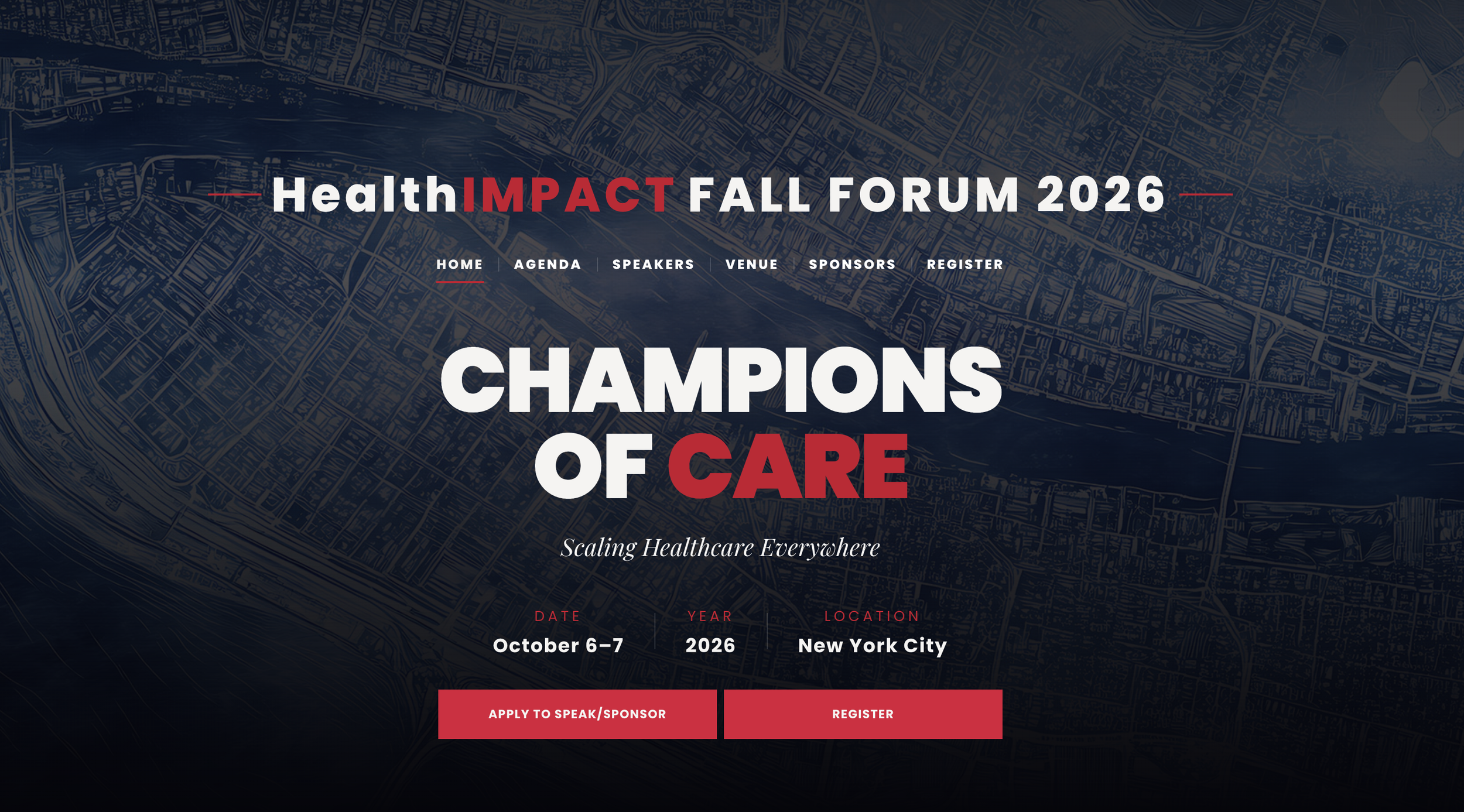
HealthIMPACT Fall Forum Oct 6 & 7 NYC Register at www.healthimpactforum.com
HealthIMPACT Briefs are insights from healthcare conferences, our own and others, written for the C-suite leaders who could not be in the room.
HealthIMPACT Live convenes the rooms where health system C-suite technology leaders solve this work together. The Operators Table dinner series, the HealthIMPACT Fall Forum, and the Digital Health Talks Podcast. Subscribe to the newsletter at healthimpactlive.com.