
Healthcare Everywhere Is Already Here
Now we have to connect it, scale it, and secure it.
The sixth edition of The HealthIMPACT Brief, an editorial series amplifying the conversations happening on the stages and in the hallways of healthcare's best events.
Healthcare everywhere already happened, and it did not happen in the hospital. It happened in the pocket and on the wrist, in the school nurse's office, in the longevity clinic that opened on Lafayette Street, in the gym, in the LLM, and in the virtual specialty practice a patient found through an ad on their phone. Health is now produced and measured more or less continuously, in rooms the health system does not operate, by companies that never asked permission and had no particular reason to. The awkward part is that the organization eventually held responsible for the clinical consequence is also the one able to see the least of it.
That is what we mean by Champions of Care: Scaling Healthcare Everywhere, and I should admit up front that we came to it at a football facility rather than at a hospital.
The Bolt
A year ago I toured The Bolt, the Los Angeles Chargers' $250 million training facility and headquarters in El Segundo, a hundred and fifty thousand square feet on fourteen acres about seven miles from SoFi Stadium.
The building is arranged around three natural grass practice fields. There are offices, a cafeteria, and a members club that looks out over the fields, and on the ground floor, with direct access to those fields, the locker room, the weight room, the hydrotherapy and recovery rooms, the sauna and steam, the lap pool, and a medical and rehab space run with UCLA Health, the team's official medical partner. Every room is themed and every room is wired. When a player eats, lifts, or practices, the result turns up somewhere the rest of the staff can see it.
The facility is amazing, but the connectivity is what struck me. (see what I did there) More than 250 Samsung displays run through the training rooms, meeting rooms, lounges, and gathering spaces, a good number of them there to put nutrition, strength, and performance information in front of the people who need it at the moment they need it. Practice load, sleep and recovery, weight room output, medical status, and film all resolve into a single picture of a single athlete. The cameras over the fields impressed me most. There must have been fifty joysticks in the control room to work them to capture practice. The position coach, the physical therapist, and the dietitian never have to reconcile three different versions of a person before they can have a conversation about him. The data is all there.
One roof. One record. One job the entire building exists to do, which is to make sure the athletes are ready to play.
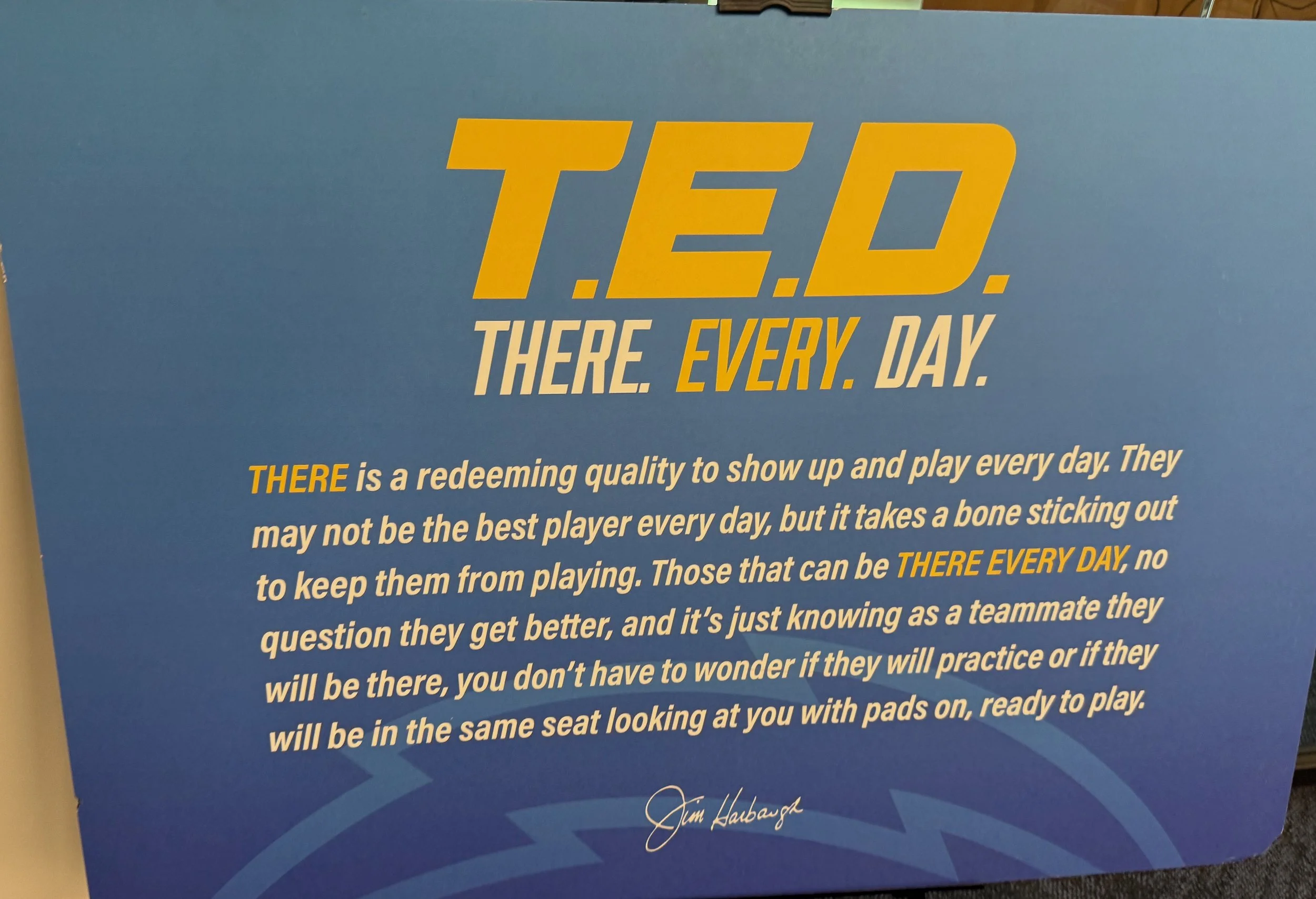
I walked out with the conclusion healthcare conferences reach all the time, that we have a sick care system, the Chargers have a performance system, and hospitals ought to be more like them. I have been telling that story ever since, and if you listen to the podcast you have heard it more than once. I had it wrong.
Hub, spoke, or axle
The Bolt is not a rebuke of the hospital. It is a closed integrated delivery system operating under conditions no health system will ever be handed: one owner, one payer who happens to be the owner, one population of fewer than a hundred people who are young, screened, and contractually obligated to show up, and one outcome everyone in the building agrees on and can measure by Sunday afternoon. There is no eligibility check, no prior authorization, no coverage change in January, and no athlete who switches plans and carries thirty years of history into a system that cannot read it.
Connection there is not an achievement. It is a byproduct of ownership. They connect because they own every room, they scale within their own walls, and they secure the whole thing by never letting the data leave the building.
No health system owns the gym, the wearable, the longevity clinic, the scan spa, or the virtual clinic. The useful question is therefore not how many rooms an organization can acquire, although some will for sure, but which part of the wheel it intends to be. Hub, spoke, or axle.
A great many companies are competing to be the hub, which is to say the place the person starts. Others are content to be a spoke and do one thing well inside someone else's model, which is a perfectly good business. The axle is the least glamorous of the three. It holds the parts in relation to one another and lets the wheel turn, and it is the only one of the roles that cannot be won by whoever builds the nicest front door.
The Chargers named the building after a lightning bolt, and you know I love a metaphor; the current does have to run between the rooms, and for the first time there is a plausible way to run it.
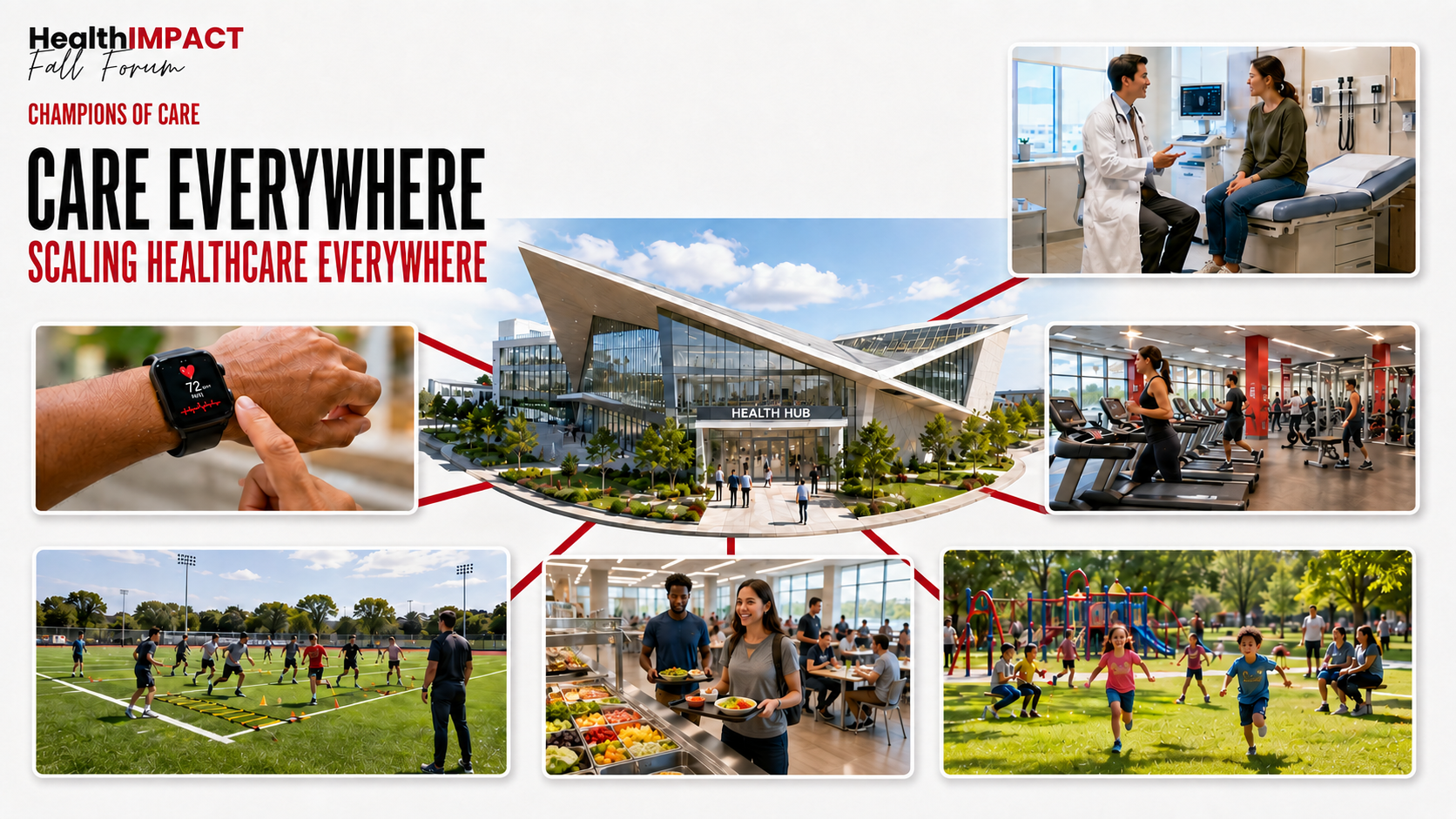
None of this is a criticism of the hospital, which is extraordinary at the work it was built to do and remains the most clinically consequential room in American healthcare. The Bolt does not handle trauma, cancer, dialysis, or a bad night in the emergency department at three in the morning, and nobody is asking it to. The question is what the health system owes the person who is already receiving care in six places and can be seen in only one.
Three answers, in order.
Connect It
Nothing connects to a person the system cannot recognize.
I walk into my gym, and they scan my finger and the turnstile lets me in.
Years ago, after two major New York hospitals merged, I arrived to deliver my youngest son and discovered that the combined system had seventeen separate entries for me. Thirty years of doctors and emergency room visits at two of the finest academic medical centers in the world, one I worked at which probably made it worse. That is not a story about a bad hospital. It is a story about what happens when two excellent institutions combine, and I suspect it would go better today. Perhaps I would only have four.
The structural version is worse than the anecdote. Pew's patient matching research found match rates inside a single facility as low as 80 percent, and rates as low as 50 percent between organizations, including organizations running the same EHR vendor. Let’s not even talk about getting handed the clipboard every time we visit a doctor outside the hospital.
That failure carries a price which is easier to defend in a budget meeting than any of the safety arguments. AHIMA, citing the Black Book, attributes 35 percent of denied claims to inaccurate patient identification, which amounts to roughly $2.5 million a year for the average hospital, set against a median operating margin Kaufman Hall put at 2.5 percent through June.
This is not an innovation problem. It is an operating problem hiding in the denial line.
A gym can solve identity with a fingerprint reader because it has one database, one purpose, and almost no consequence for getting you wrong, and healthcare is admittedly more complicated than that. It is not seventeen records complicated.
Scale It
The industry has been reading this verb too narrowly. Scaling healthcare everywhere is not a build order for virtual visits, remote monitoring, and hospital at home, all of which are good programs and none of which is the point. The point is that the rooms already exist and somebody else is operating them.
Neko Health opens its first US clinic in SoHo on September 24, two floors and seven scan rooms at 300 Lafayette, on the back of a $700 million Series C. The scan costs $499 and the results arrive during the same visit. Love.Life in El Segundo puts medicine, nutrition, fitness, recovery, and community under one roof, which means somebody has built the consumer version of The Bolt about a mile from the original. Longevity clinics, high-performance gyms, wearables, and virtual specialty practices are not a passing category, and they are where prevention, behavior, and continuous data now actually live.
None of them is replacing the hospital, because none of them has the depth, the capacity, or the responsibility, and nobody is building a hospital in SoHo. What they are taking is the relationship. Neko reports that 75 percent of its members book and prepay their next scan before they leave the building, which is a recognition statistic before it is a wellness statistic. People return to places that remember them.
So a healthy and engaged forty year old can build a fifteen year data relationship with a company that is not a health system, and then a finding becomes a diagnosis, or a chronic condition, or a bad night, and that person arrives at the door of the only organization capable of managing the full clinical consequence, where we too often hand them a form.
Losing the visit is survivable. Losing the history is not.
Secure It
Every room the system connects to is a room it then has to defend, which is why this is the verb most roadmaps leave until last.
Each new source is a business associate, an integration, a set of credentials, and a standing path into the environment, and the trend line is already visible. The HIPAA Journal's analysis of the OCR breach portal found business associate involvement in an average of 20 percent of reported healthcare breaches between 2009 and 2017, 34 percent between 2018 and 2026, and 43 percent in the first six months of this year.
Then add the axle. Every model and agent doing the reconciliation work is another identity in the environment with its own credentials and its own access, and most organizations cannot produce a list of the non-human identities already running inside their walls. That was the argument that ran through our cybersecurity session at HPN West Coast this spring, and it is the reason the topic gets a session at the Forum rather than a slide.
Connection without governance is not integration. It is exposure with better dashboards.
Champions of Care
Every session at the Fall Forum feeds the 2027 Decision List, an operator-built answer to what health systems should scale, retire, secure, and fund next. Day One treats performance as a working benchmark rather than an aspiration, an operating model in which every room can see the same person. Day Two turns that benchmark into the payment question and closes with the List.
What matters more than the agenda is the room: chief information officers, chief medical information officers, chief nursing informatics officers, chief information security officers, and the digital, clinical, and finance leaders who have to live with whatever the others decide. None of that belongs to a single executive, which is why health systems should not send one person and expect the answer to survive the trip home.
A champion is not the organization that does everything. It is the one capable of connecting the system around the person it serves.
HealthIMPACT Fall Forum. October 6 to 7, 2026. Microsoft Times Square, New York. Health systems bringing three or more qualified leaders can request a Governance Committee Group Pass through September 22.
HealthIMPACT Fall Forum Oct 6 & 7 NYC Register at www.healthimpactforum.com
HealthIMPACT Briefs are insights from healthcare conferences, our own and others, written for the C-suite leaders who could not be in the room.
HealthIMPACT Live convenes the rooms where health system C-suite technology leaders solve this work together. The Operators Table dinner series, the HealthIMPACT Fall Forum, and the Digital Health Talks Podcast. Subscribe to the newsletter at healthimpactlive.com.