
Unrecogonized Clinical Deterioration Becomes a Sentinel Event
What the 2027 Joint Commission changes mean for the hospital leaders who have to answer for them.
The sixth edition of The HealthIMPACT Brief, an editorial series amplifying the conversations happening on the stages and in the hallways of healthcare's best events.
This conversation started after our Operators Table dinner in NYC in June. HealthIMPACT community leader and speaker Dr. Komal Bajaj shared during dinner that on January 1, 2027, patient harm associated with unrecognized clinical deterioration becomes a sentinel event. It is one of five new events on the updated Serious Reportable Events list Joint Commission and the National Quality Forum announced they were aligning in January 2026. The SRE list had not been revised since 2011.
The same update expands the settings the list applies to. That's what matters to health IT leaders in our community. Aligning Patient Safety Event Reporting: 2025 Updates to Sentinel Events and Serious Reportable Events, Joint Commission and NQF, January 2026, updated May 2026. The transition takes effect no later than January 1, 2027 across all accredited organizations. The Sentinel Events List will consist of 31 events: the 28 SREs plus three retained legacy workforce safety events. Thirteen of the 28 align with current sentinel events. Fifteen are new for Joint Commission. Reporting to Joint Commission remains voluntary, though more than 30 states and the District of Columbia have their own SRE reporting requirements.
We picked Champions of Care: Scaling Healthcare Everywhere as this year's Forum theme back in February. Joint Commission appears to have picked the same theme. Theirs comes with a deadline.
I spent a lot of time this summer reading Rural Health Transformation Program press releases and thought I was working on a money story. I was reading the wrong document.
THE LIST NOW COVERS THE PLACES CARE ACTUALLY HAPPENS
NQF expanded applicable healthcare settings to all patient care environments and listed the categories: ambulatory and outpatient, including mobile clinics and pre-hospital transport. Hospital and acute, including critical access. Post-hospital and sub-acute, including skilled nursing and swing bed. Home care, including hospital at home. And virtual care, defined as telehealth, telemedicine, and telemonitoring.
Telemonitoring is a named setting. The report also defines a patient encounter as an interaction with an associated location or modality, including the EHR, phone, email, and other telemedicine methods, and covering both synchronous and asynchronous communication.
For anyone running technology inside a health system, that is the operative change. The list is no longer a hospital document.
The other definition worth knowing is how the report handles preventability. To qualify as an SRE, an event has to be serious and largely preventable, and largely preventable is defined as likely avoidable by any means currently available within the generally accepted performance standards of care. The guidance defines "available" as technologies, clinical methods, or interventions accessible within the healthcare system at the time of the patient encounter.
How that criterion gets applied as continuous monitoring becomes more common is an open question, and a good one to put to the people who wrote it.
MEANWHILE, THE MONEY IS BUYING MONITORING
The Rural Health Transformation Program is moving $50 billion through the states over five years. All 50 states received first-year awards averaging roughly $200 million. The money goes to states rather than hospitals, so a system's position depends on whether it sits inside its state's plan or outside it.
Most of it also cannot go to hospital operations. Provider payments are capped at 15 percent in a given budget year and capital expenditures at 20 percent, and funds cannot duplicate existing reimbursement. The balance is going to technology and workforce.
New York is the example closest to home. On September 4, CMS announced $76 million to New York out of the state's $212 million first-year award, for regional coordination and technology-enhanced primary care. The stated purpose is coordination among rural hospitals, primary care providers, federally qualified health centers, behavioral health providers, and community organizations, with a specific line about strengthening transitions across the continuum of care.
The same week, CMS announced $25 million to Michigan for health IT modernization, telehealth, and remote monitoring, and a new West Virginia award covering home dialysis access, medical transportation, and regional mobility coordinators. Alaska is deploying an AI imaging network across 21 hospitals. South Dakota led its announcement with IT modernization, cybersecurity, and interoperability.
Two things are happening at once. Federal money is putting monitoring and coordination technology into homes, skilled nursing facilities, and critical access hospitals. The sentinel event list is extending to those same settings. Nobody planned that convergence, and it is worth thinking through before January.
MEETS MINIMUM
Jason Taylor, chief growth officer at Neteera, which is a HealthIMPACT annual program partner, borrowed a phrase from software and asked what becomes the new "meets minimum." He said meets minimum is going to be knowing what is going on with your patient. Inpatient, outpatient, transitional care, and in the home if you have declared that you are managing that patient at home.
How you act on what you know, and what you are held accountable to, is the part still being negotiated. The obligation to know looks less negotiable.
That is the question underneath our Fall Forum theme this year, Champions of Care: Scaling Healthcare Everywhere. If care follows the patient, accountability follows the patient. The technology backbone is arriving faster than the care models that would use it, and the staffing, escalation, and documentation questions on top of that backbone still don't have settled answers.
Which is why the session exists
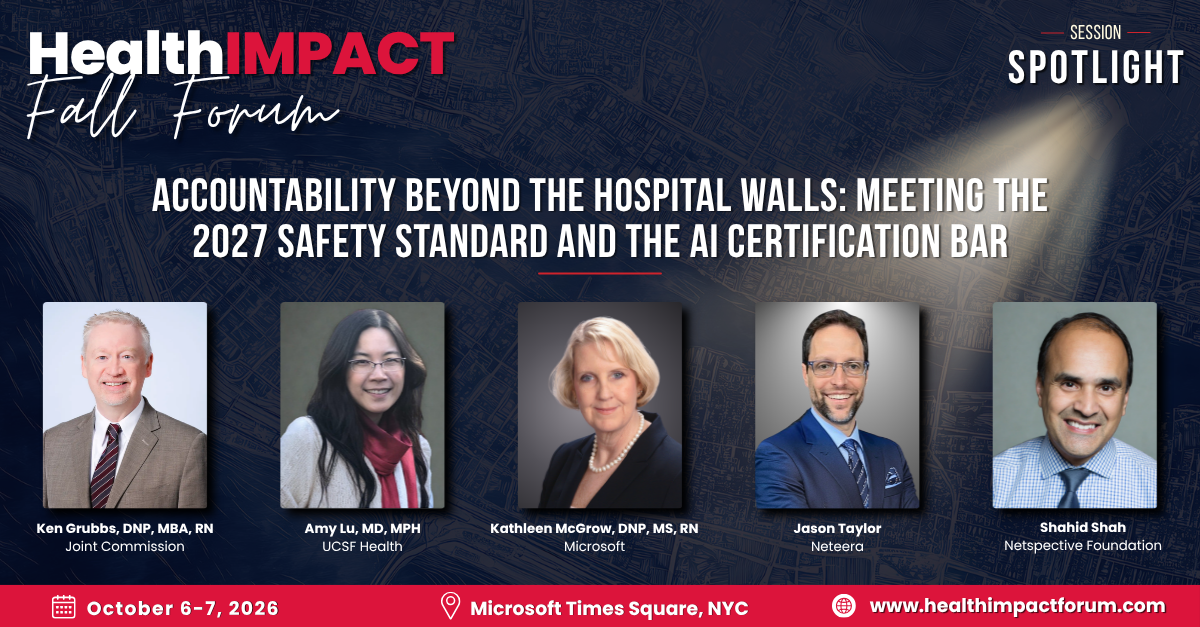
HealthIMPACT Fall Forum 2026 - Accountability Beyond the Hospital Walls Meeting the 2027 Safety Standard and the AI Certification Bar
We are glad to have Joint Commission joining us. Accountability Beyond the Hospital Walls brings together Ken Grubbs, DNP, MBA, RN, EVP of Accreditation and Certification Operations and Chief Nursing Officer at Joint Commission; Amy Lu, MD, MPH, Chief Quality Officer and Vice President at UCSF Health; Kathleen McGrow, DNP, MS, RN, Chief Nursing Innovation Officer at Microsoft; and Jason Taylor of Neteera, moderated by Shahid Shah, chair of HealthIMPACT Live.
The panel takes up the unified 2027 list and where state and accreditation exposure is real, what the Responsible Use of AI in Healthcare certification asks organizations to demonstrate, and where surveillance, escalation, and documentation break down outside the hospital. The person who owns the survey process sitting with the leaders who have to pass it is not a panel we could have assembled a year ago.
The companion session, Healthcare Across Distance: Coverage, Capacity, and What the Money Actually Buys, takes up the other half with Andrea Daugherty, MHA, CIO of Arrowhead Regional Medical Center, on where coverage fails across distance, which technologies extend clinical capacity in practice, how RHTP dollars reach providers through state plans, and what survives when the funding ends.
WHAT TO DO BEFORE JANUARY
Three moves. Start with the first.
Name an owner of record for every monitoring feed that touches your patients and does not sit inside your four walls. A person on your org chart. Post-acute, home, virtual, and any site your system operates as a hub in a state plan. This is the cheapest item on the list and the one to finish first.
Run the fifteen new events against your reporting workflow. Your quality team is likely on this. Your IT and analytics teams may not be, and the taxonomy has to change in the same systems that feed your grievance workflow. Begin the mapping now rather than validating coding in December.
Read your state's SRE statute. Reporting to Joint Commission stays voluntary. Reporting to your state may not, and requirements vary. If you operate across state lines, you have more than one answer.
Previously in this series: the integration layer thesis. Coming next: more on Rural Health.
HealthIMPACT Briefs are insights from healthcare conferences, our own and others, written for the C-suite leaders who could not be in the room. HealthIMPACT Live convenes the rooms where health system technology and operational leaders solve this work together.
One ask: join us October 6 and 7 at Microsoft Times Square. See the full agenda and register
Every session at the Fall Forum feeds the 2027 Decision List, an operator-built answer to what health systems should scale, retire, secure, and fund next. Day One treats performance as a working benchmark rather than an aspiration, an operating model in which every room can see the same person. Day Two turns that benchmark into the payment question and closes with the List.
What matters more than the agenda is the room: chief information officers, chief medical information officers, chief nursing informatics officers, chief information security officers, and the digital, clinical, and finance leaders who have to live with whatever the others decide. None of that belongs to a single executive, which is why health systems should not send one person and expect the answer to survive the trip home.
A champion is not the organization that does everything. It is the one capable of connecting the system around the person it serves.
HealthIMPACT Fall Forum. October 6 to 7, 2026. Microsoft Times Square, New York. Health systems bringing three or more qualified leaders can request a Governance Committee Group Pass through September 15th.
HealthIMPACT Fall Forum Oct 6 & 7 NYC Register at www.healthimpactforum.com
HealthIMPACT Briefs are insights from healthcare conferences, our own and others, written for the C-suite leaders who could not be in the room.
HealthIMPACT Live convenes the rooms where health system C-suite technology leaders solve this work together. The Operators Table dinner series, the HealthIMPACT Fall Forum, and the Digital Health Talks Podcast. Subscribe to the newsletter at healthimpactlive.com.