
Will AI Be the Spirit Airlines of Healthcare?
Only if we can protect safety while prioritizing affordability, access, reliability, comfort, and convenience
The sixth edition of The HealthIMPACT Brief, an editorial series amplifying the conversations happening on the stages and in the hallways of healthcare's best events.
This summer's argument was whether AI-only care becomes medicine's economy class.
Ezekiel Emanuel and Abe Baker-Butler of Penn, writing in JAMA with Vinod Khosla and Neal Khosla, argued that autonomous AI will outperform AI-assisted physicians at the core cognitive work of medicine, and described Robert Wachter's book A Giant Leap as predicting AI-only care would be the economy cabin. Wachter, who chairs medicine at UCSF, called that a straw man. He never said second-rate. Some patients may well prefer it. He would rather take a Waymo than an Uber. Emanuel and Baker-Butler took the argument to STAT on September 9.
John Whyte, who runs the American Medical Association, told Emanuel on LinkedIn that performance on discrete tasks is not evidence that autonomous AI can assume "the contextual, longitudinal and accountable work of practicing medicine." In STAT on September 9 he put it harder. "Would you want artificial intelligence to tell you that you have cancer?"
Whyte, arguing the point on LinkedIn, wrote that even with autopilot, most of us would not board a plane without a pilot in the cockpit. Emanuel's answer to the objection that we have no licensure or liability structure for autonomous AI was to build them, not reject the technology. Neither man says the structure exists today.
Because I love a metaphor, I'll take it further.
What if AI becomes the Spirit Airlines of healthcare
Spirit got you from point A to point B. You arrived in one piece. Your ass hurt the whole time.
It sold access at the expense of attention, flexibility, reliability, and legroom. That trade worked because regulators enforced safety standards. The passenger in 32B got the same certified aircraft and the same trained crew as the passenger in 2A. You did not take a risk on the safety standard, because that was not negotiable.
Spirit itself did not survive. I don't begin to know all the reasons, but that also isn't relevant here, and I am by no means predicting the fall of AI. What I am saying is that healthcare has yet to create non-negotiable safety standards for AI-delivered care. We do not know which parts of the physician bundle are comfort, which are judgment, and which keep the patient alive. In aviation, the lines between comfort, convenience, and safety are clear. In medicine, those lines are the entire product, and we have almost no outcomes data on AI-delivered care at scale.
Wachter's doorman
Wachter's defense of the physician is not about accuracy. It is the doorman. The door opens itself and has for seventy years. The doorman is there because he knows who belongs in the lobby, signs for the packages, and takes the dog out when you are stuck at the office. The holiday tip is real money, and people pay it, because they know what they are buying. His point is that the human is a bundle of services, most of them invisible until they are gone.
We already sell the upgrade
We talk about a potential consequence of all this innovation: that the wealthy get doctors and everyone else gets an algorithm, as though that were a forecast. Half of it is already here.
We sell the upgrade today. Concierge medicine, direct primary care, Sollis Health memberships for emergency-level care with specialists on speed dial.
What American healthcare has never had is a decent economy cabin at all. Most people are not flying first class. A lot of them are not flying at all. They wait weeks for a primary care appointment, drive past a closed rural hospital, or use an emergency department as a clinic because it is the only door that opens.
On some clinical tasks, the accuracy argument is getting harder to dismiss
Last November, the American Heart Association put three cardiologists on a main stage at Scientific Sessions to play Jeopardy against AI models on real ECGs and echocardiograms, with audience voting live. AI won, nine to eight. It is online here.
One competition does not settle anything. But run that AI tool in a critical access hospital in West Texas, and the model is the same model NYP has. What surrounds it is not. The echo tech, the cardiologist who can act on the finding, the appointment three days out instead of three months. That is an access argument and a strong one. It is not an outcomes argument.
What the cardiologists had that the model did not
Dr. Effie Andrikopoulou of the University of Washington was one of the cardiologists on that stage. Talking about patients who arrive at clinic quoting chatbot output, she said the AI tools sound confident every time and are right some of the time, and that combination is very dangerous.
Watching her and her colleagues work an ambiguous case, you see the opposite. They hold three possibilities at once, argue with each other, and refuse to commit until the picture resolves.
The easy read is that clinicians weigh better than machines. I doubt that is the whole of it. Weighing is a processing problem, and machines are good at processing, and no law of nature says a cardiologist holding four possibilities beats a model holding four hundred.
What differs is what each one stands to lose. A cardiologist who misses it will remember the miss, may be sued for it, and is the one who walks into the room and tells the family. The model has no license to lose and nobody to face. Experience and knowing the patient do real work in that room too, and I cannot measure how much. But it is a fair question what changes when the thing making the call carries no consequence for getting it wrong.
Training and Upskilling the Caregivers
Which lands on the workforce, and somebody is working on that. Dr. Stephen Klasko took over as chief executive of the Health Assurance Foundation this summer. Hemant Taneja, who co-wrote UnHealthcare with him a decade ago, put the mandate this way: AI will cut the administrative burden he pegs at roughly a third of every healthcare dollar, and cutting that cost means transforming the work of the people who currently do it. Nurses, physicians, navigators, schedulers. HAF's job is workforce reskilling, education, and the community health jobs of the future.
Taneja's original thesis was that care should be accessible at any address. That is the same idea we named this year's Forum after, and the same idea CMS just put fifty billion dollars behind. The open question is what has to be true at those addresses, and who is trained to make it true.
The money is already moving
On December 29 2025, CMS announced Rural Health Transformation Program awards to all 50 states. Fifty billion over five years, first-year awards averaging $200 million per state. The money starts flowing October 1.
The program funds plenty unrelated to AI. But read the state proposals and much of the new access runs through telehealth, remote monitoring, shared data platforms and, increasingly, AI. Texas named one of its six initiatives Lone Star Advanced AI and Telehealth.
Part of the floor is written
On June 1, Joint Commission launched its Responsible Use of AI in Healthcare certification, built with the Coalition for Health AI and open to any healthcare organization whether or not it is accredited. Jonathan Perlin gave the reason plainly: more than 80 percent of physicians are already using AI professionally.
Be precise about what it covers. The certification assesses an organization's governance, safeguards, monitoring, and education. It does not certify individual AI tools. FDA does that for the ones that qualify as devices.
So we certify some of the aircraft, and we have started certifying the airline's operating discipline, voluntarily. Whyte is right that nobody boards without a pilot. The question he does not take up is what the pilot is certified to do, and whether the passenger in 32B gets the same one.
Which leaves a narrower question. Should a state spending RHTP money require the providers it funds to demonstrate that governance standard before the money moves? I do not know whether any state has written that into its contracts.
Klasko will be with us October 6 and 7 at Microsoft Times Square. Come talk about it. Register here.
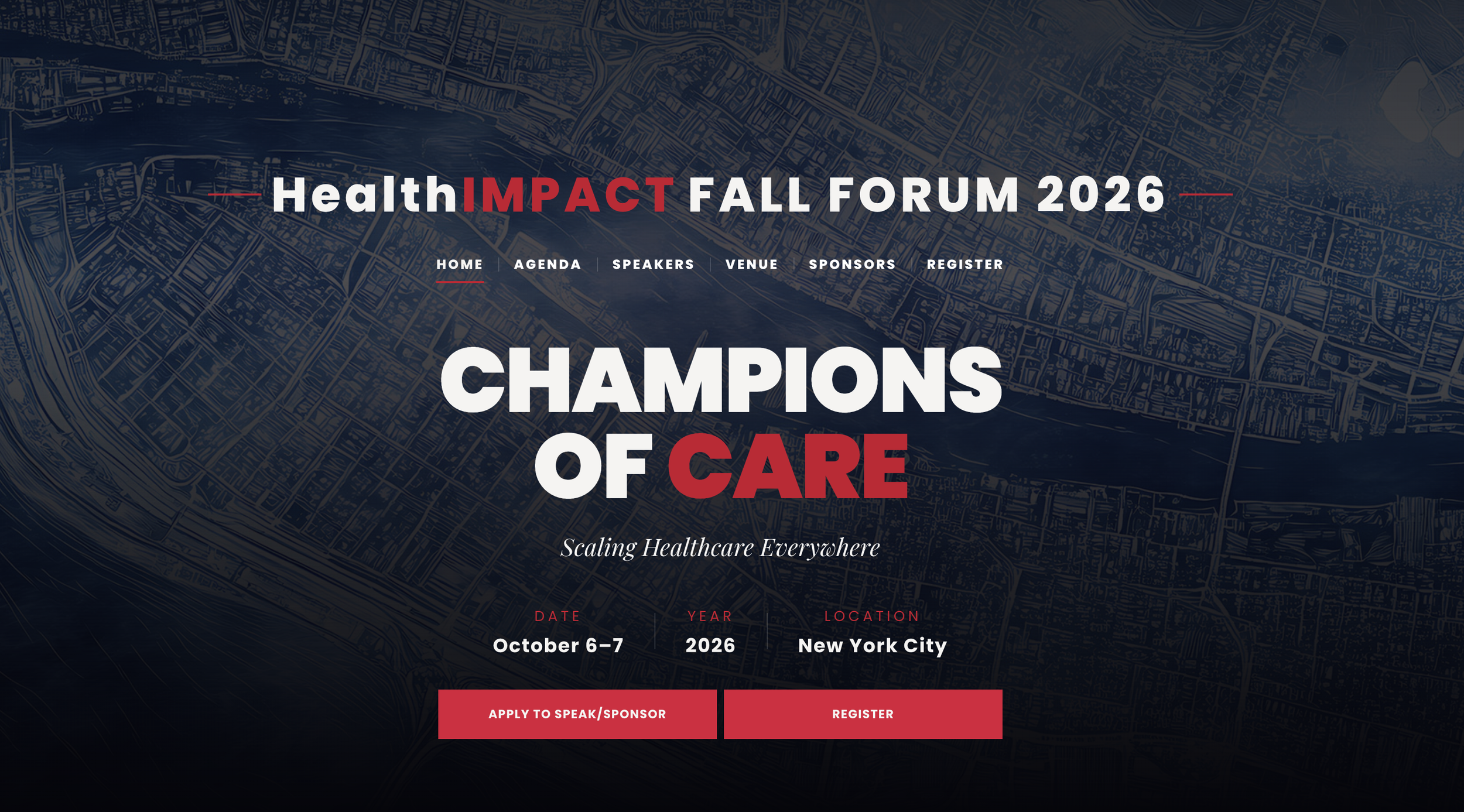
HealthIMPACT Fall Forum Oct 6 & 7 NYC Register at www.healthimpactforum.com
HealthIMPACT Briefs are insights from healthcare conferences, our own and others, written for the C-suite leaders who could not be in the room.
HealthIMPACT Live convenes the rooms where health system C-suite technology leaders solve this work together. The Operators Table dinner series, the HealthIMPACT Fall Forum, and the Digital Health Talks Podcast. Subscribe to the newsletter at healthimpactlive.com.